01. Order
Tell us about your dog
Name, breed and which paws need shoes. After you order, we email you a link where you add your dog’s measurements, photos and notes about the paws. Open the link before you measure: it shows exactly what we need.
Made to measure for your dog Ships in 2–3 weeks after measurements

Fit, explained
It’s the shape, the strap design and the strap positioning. Here is what we learned from measuring the paws of more than 40 breeds.
Every shoe is made from your dog's own paw measurements.


Why traditional dog shoes fall off
Most dog shoes are made for one paw shape—long and narrow. If your dog has round or wide paws, no strap will hold them. We start with the shape, then the millimetres.
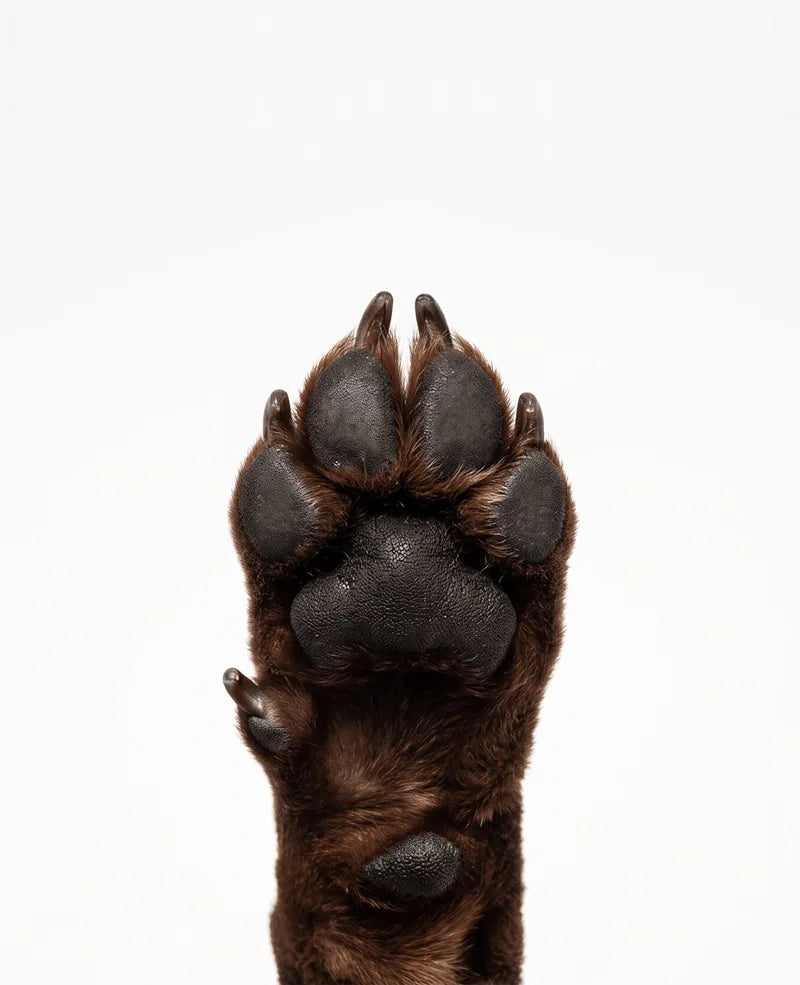
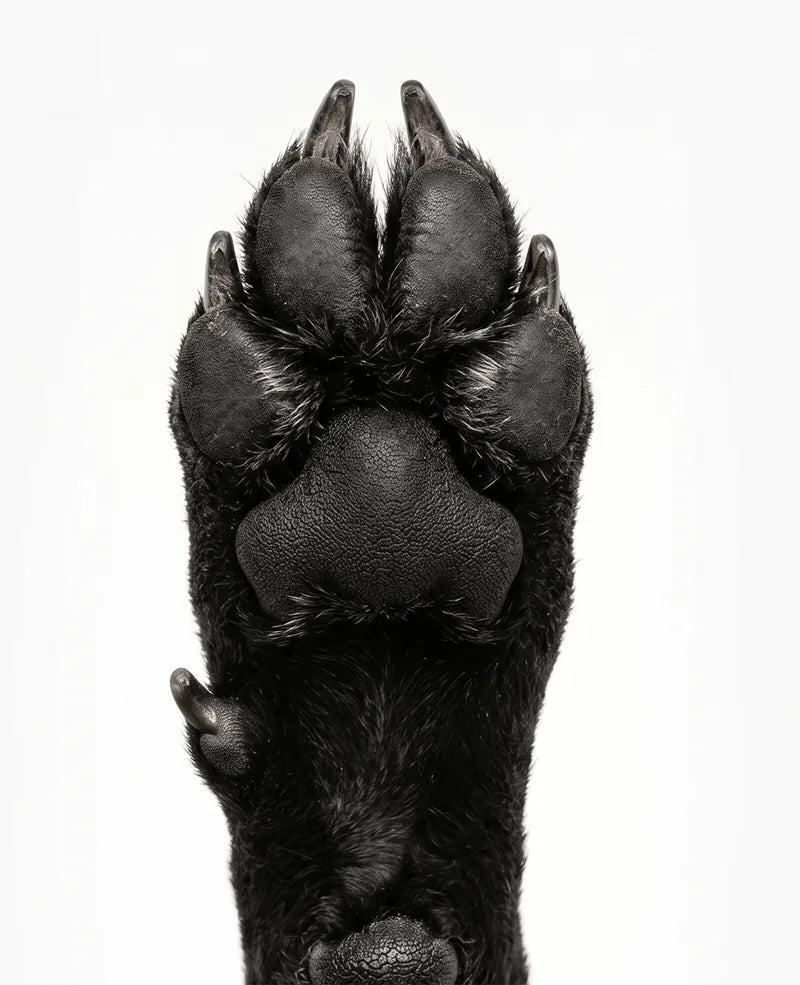
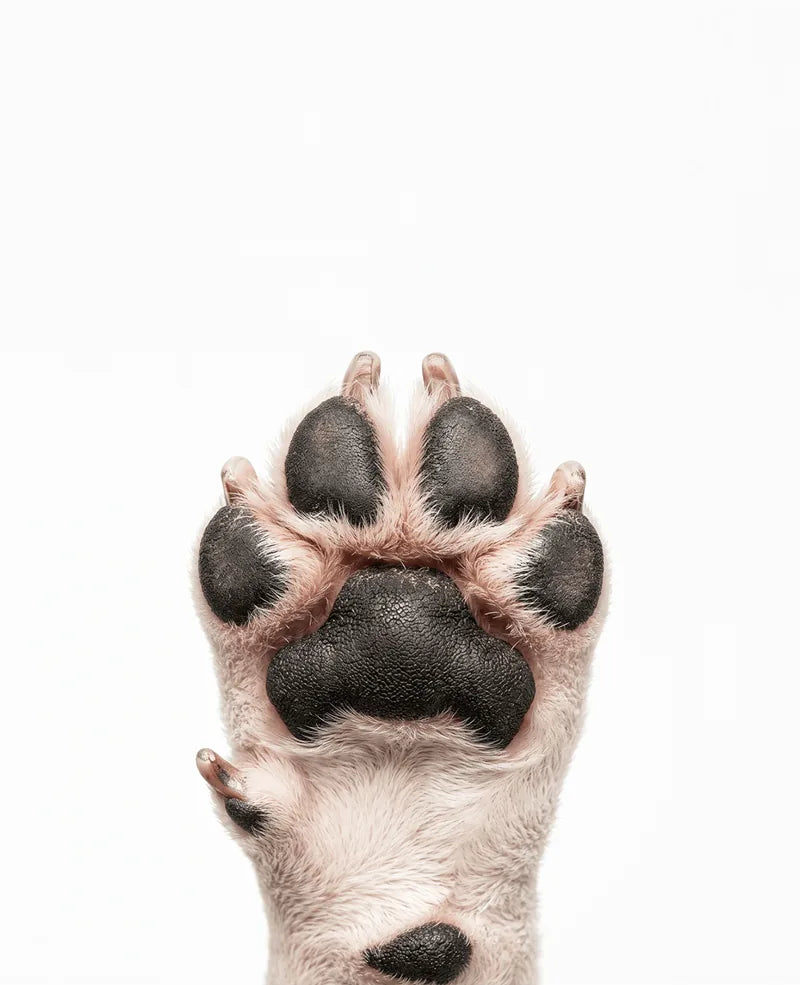
Shape, not just size
Most dog boots come in small, medium and large. But in our measurements, the bigger difference between breeds is shape. Here is the average front paw of six breeds we measure often, from the roundest to the longest:
| Breed | Paw shape | Front paw width | Front paw length |
|---|---|---|---|
| French Bulldog | Almost round | 51 mm (2.0 in) | 53 mm (2.1 in) |
| Miniature Dachshund | Round | 41 mm (1.6 in) | 43 mm (1.7 in) |
| Corgi | Slightly oval | 56 mm (2.2 in) | 64 mm (2.5 in) |
| Staffordshire Bull Terrier | Slightly oval | 53 mm (2.1 in) | 61 mm (2.4 in) |
| Dachshund | Slightly oval | 48 mm (1.9 in) | 56 mm (2.2 in) |
| German Shepherd | Long oval | 71 mm (2.8 in) | 97 mm (3.8 in) |
A French Bulldog's front paw is almost as wide as it is long. A German Shepherd's paw is only about three quarters as wide as it is long. Take a shoe that fits a Frenchie and scale it up to a German Shepherd's paw length, and it would be nearly 30% too wide. Scale it to the width instead, and it would be far too short. That is why “size large” rarely fits.

Strap position
A shoe stays on because the leg there is narrower than the paw, so the strap has a ledge to sit behind. On a French Bulldog's back leg, that difference is only about 15 mm (0.6 in). On a German Shepherd it is about 25 mm (1 in). Add the Frenchie's short legs, and there is very little to anchor a shoe to. In our experience, that is the main reason ordinary boots spin around or slide off short-legged breeds.
This is why we use different straps for different breeds. Where the strap sits is vital for keeping a shoe on, especially on short-legged breeds such as the English Bulldog, Dachshund, French Bulldog and Corgi. When we position the strap, we take the carpal pads and dewclaws into account.
Front and back
In most breeds we measure, the back paws are noticeably smaller than the front paws. How much smaller depends on the breed:
| Breed | Back paw narrower than front | Back paw shorter than front |
|---|---|---|
| Dachshund | 19% | 18% |
| Staffordshire Bull Terrier | 8% | 15% |
| German Shepherd | 6% | 13% |
| French Bulldog | 10% | 4% |
There are exceptions too. In the Corgis and Miniature Dachshunds we have measured, the back paw is slightly longer than the front, even though it is narrower. No size chart catches that.
This matters when the paw that needs protecting is a back paw. In DM, for example, the signs begin in the back legs. Yet many boots are sized from a front paw, or sold as a set of four identical shoes. Based on our averages, a back shoe for a Dachshund sized from the front paw would be almost a fifth too big in both directions. In our experience, a loose shoe on a scuffing paw twists, rubs and comes off.
Our rule of thumb: measure the paw that needs protecting, not the one that is easiest to measure, and measure both sides. In our data, left and right paws are often not identical. Our How to Measure guide shows you how.
Read the full article: what we learned from measuring paws of over 40 breeds
Side by side

“The shoes actually stay on my dog's feet”
This is the first pair of shoes we've gotten for my dog that actually stay on for the whole walk, despite slightly dragging her back feet a bit. Even before her mobility challenges, we've struggled to find shoes for her that fit her paws but stay put around her skinny ankles. These are carefully designed, with thoughtful details, and easy to put on once I got the hang of it. They bring me peace of mind to know her paws are protected and won't get scraped up. The custom fit was important to us and worth it!
Ships 2–3 weeks after measurements
01. Order
Name, breed and which paws need shoes. After you order, we email you a link where you add your dog’s measurements, photos and notes about the paws. Open the link before you measure: it shows exactly what we need.
02. Measure
Measure your dog’s paws at home or at your vet. Use a caliper. A measuring tape isn’t accurate enough.
How to measure03. Input
Enter your dog’s measurements through the link in your order confirmation email. Your custom shoes ship 2–3 weeks after we receive the measurements.
FAQ